Whether or not using new media has changed my writing style is difficult to determine. I have been on a computer, albeit an old Apple that used those huge floppy disks, since elementary school. I've never really given writing with a pen and paper a chance in the sense that I could develop my writing skills without the influence of computers and new media. There was no way I could ever compare the two since new media has always been a huge factor in my literary maturity. I suppose if I had to make a guess, considering I have physically written a few papers, using computers and new media has provided me with unnatural editing powers with copy and paste features and instant results for information inquiries using search engines. If I needed an article to backup my claims or a book to quote I wouldn't immediately think to go to my local library, but instead go online. The speed and availability of the internet has probably quickened the development of my writing style as I was hardly ever discouraged or prevented from accessing any information which would have slowed me down. Perhaps without computers, the delay in finding research material would have given me time to think more critically and analytically about the topic of my paper, but, as I said before, there's no way of knowing now because I've become reliant, if not addicted, to the immediate gratification of searching new media sources.
In the days before the internet when the personal computer was an emerging idea, newspapers, radio, and television were all very flat in how they relayed information. If a TV show referenced a news article then the viewer would have to go find it outside of watching TV. If radio referenced a book the viewer would have to visit a library or a bookstore to check it out. If a newspaper reported on a movie one would have to go see it. There was no direct connection if the audience wanted more information. As technology advanced and the internet was a growing media vehicle, everything one would do physically could be done much quicker virtually. All it takes is a link to an online book store, a clip from a movie or TV program, or a news article. Instead of everything being so isolated in the real world, the internet was a web of information that helped shape and define new media. Suddenly, TV, news, radio, and so much more was all on the internet but they weren't separate like in their old media forms, they were combined so that a news article had a complementing set of photos, an audio interview, and a video version of the story. Everything was converged into one effectively blurring the line between text and image. On the other hand, maybe this was destined to be the progression of media where it all comes together as one. It could be that this ambiguity between media is the best way to be informed where everything is packaged in one place for convenience in a world as complex and busy as today.
The future of new media as the Museum of Media History displayed in "Epic" is beyond ridiculous. Google will not take over the world. There will always be competition on the internet since it's so easy to create a functioning website, as opposed to forming a physical business outside of the online world, and internet user interest is always shifting. During the long period of Yahoo! search domination, no one ever expected that the same Yahoo! today would be looking for someone to buy their company. When MySpace was the top social network, no one could have predicted Facebook usurping it. Even now, Facebook is struggling to hang on to disgruntled users with the rise of Twitter. Google too may see a day when they simply cannot survive on the internet. Although, Google is one of the only online companies to stay fresh and popular with constant expansion, experimentation, and updating. There really is no way to know what the next big thing will be on the internet.
Over the past semester, I wouldn't say I've encountered an eye-opening experience concerning my understanding or use of new media, but I have grown. All of this new media has exposed me to a wide assortment of ideals that has helped further form my individual writing style. I've learned a few tricks and tips along the way, which, although only small tweaks, they have a significant impact on the audience. I had more fun teaching others then anything else.
Tuesday, April 14, 2009

Tuesday, April 7, 2009
#9 - Rules of the Interactivity

Interactive is just another broad term that doesn't mean much without further detail. It can be condensed to mean changing one factor and seeing the effects that has on other factors. Saying something is "interactive" is like saying someone is "special."
Len Manovich puts it best in his "The Myth of Interactivity" when he breaks down interactivity into different kinds of "structures and operations." To me, there are many levels of interaction in varying forms, but I'll focus on new media on the internet. Interaction can be as simple as clicking a link to another page or as complex as building your very own page. But not all interactivity is created equal.
Anyone can hyperlink in order to have people "interact" but is it what users want? Just because there's a link somewhere doesn't mean that it's an effective use of interactivity. If there's a story that has a long and detailed history then an interactive timeline would allow readers to customize there own viewing experience. Google offers anyone to personalize their own homepage with iGoogle where users can drag, drop, and organize anyway they wish at any time. But it doesn't have to be complicated; even just having links to photos or videos for reference would suffice as interactivity if used coorrectly.
Interaction is really about the individual user experience. If there isn't any consideration as to what method of interaction is best then there's a disconnect between the audience and what is being portrayed. The whole point is to get the user actively engaged and actually want to interact. Interaction without will isn't worth interacting with.
Thursday, March 26, 2009
#8 - Audio Not Related
When it comes to podcasts, audio is everything. Even if you have the most amazing visuals, if the right audio isn't working well with them then all is lost. The backbone of a podcast has, is, and always will be the audio.
Should there be music playing in the background when I'm speaking? What about when this person is talking? What song would be appropriate here? What do I want the listener to feel? Choosing the best sound selection and when in a podcast depends on many factors. Sound isn't just limited to music either, there are natural pops, "room noises," and voices.
Natural pops have a huge roll in creating a specific scene or location in the listener's mind. If you have birds chirping and the wind blowing then the audience gets a feeling of being outside. Add in some dogs barking and maybe a few soft conversations and the listener feels like they're in a park. Room noise is like the silence you experience when in a... well a room. It's not perfect silence, it's comforting silence. Voices are pretty self explanatory, but it's the sounds you combine with them that are important.
It's no easy task to pick what goes together but when you get it right, audio makes all the difference in the world. Choose wisely.
Should there be music playing in the background when I'm speaking? What about when this person is talking? What song would be appropriate here? What do I want the listener to feel? Choosing the best sound selection and when in a podcast depends on many factors. Sound isn't just limited to music either, there are natural pops, "room noises," and voices.
Natural pops have a huge roll in creating a specific scene or location in the listener's mind. If you have birds chirping and the wind blowing then the audience gets a feeling of being outside. Add in some dogs barking and maybe a few soft conversations and the listener feels like they're in a park. Room noise is like the silence you experience when in a... well a room. It's not perfect silence, it's comforting silence. Voices are pretty self explanatory, but it's the sounds you combine with them that are important.
It's no easy task to pick what goes together but when you get it right, audio makes all the difference in the world. Choose wisely.
Thursday, March 19, 2009
#7 - So I Herd U Liek Vizualz
 4th generation iPod from 2004
When podcasts became popular in late 2004, there was one mp3 player that dominated the market: the iPod 4th generation. The whole reason why an audio clip made for downloading over the internet was called a podcast was because the first broadcasts were made for the iPod. The iPod, at that time, was limited to audio only until the introduction of the iPod Photo. Looking at pictures in color was now a possibility, but was never intended to play videos. In essence, the iPod was an audio only device so it would make sense that podcasts made for it would only contain sound.
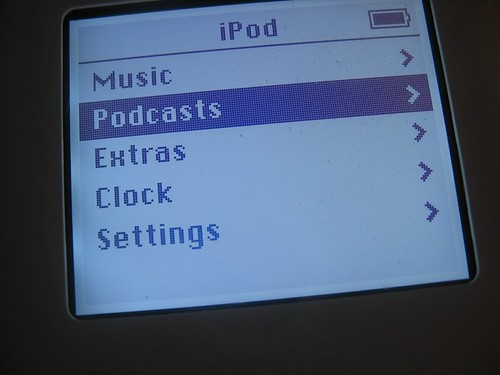 Podcasts on 2004 iPod menu
As the iPod lineup grew and its capabilities expanded to include video playback and WiFi connectivity, podcasts could now be coupled with a combination of audio and visuals. Yet many podcasters stuck to the traditional audio only format. Once iPods focused more and more on the video aspect with a larger screen and downloadable games like on the iPod Touch, podcasts weren't keeping up. Now iPod users can play YouTube clips, surf the internet, and use a slew of applications. So why would anyone want to download any podcast, let alone one without any visuals?
 5th generation iPod playing a podcast
Podcasts were a great idea at the time since one could download news broadcasts, comedy routines, stories, interviews, and other original content which acted as a nice break from the music. It made sense that they were so popular when all people had were devices that only played audio files. When the color screen came along, it was a case of video killed the podcast star. Why would anyone rely on podcasts to get alternative entertainment when he/she could upload their favorite TV shows, movies, and online clips? Podcasts had a niche following already, but were losing new subscribers fast when the process of having to download the podcasts and then uploading them became too much a hassle for many. Customers of mp3 players were no longer looking for just a music playing device, they wanted multimedia and different applications at their fingertips. Podcasters were following suit by releasing video clips, but, besides devoted fans, no one wanted to explore audio podcasts anymore when most of them could be found elsewhere like radio, television, and the internet.
 Podcasts on the iPhone and iPod Touch
In order to attract new subscribers, podcasters need to make their content more appealing. Instead of simply putting parts of or full radio segments online for distribution through podcasts, they should include original visuals. When a host mentions a celebrity, book, quote, or other reference, there should be a visual that corresponds. That way the podcasts are unique and, therefore, desireable as well as enticing to those wanting more than just another audio file. There might also be a solution in interactivity within a podcast too. Perhaps a "choose your own adventure" podcast. Although there will always be those who desire simple audio podcasts, that audience won't be around forever and with changing times comes a shift in expectations and interests. Podcasts should look towards the future instead of dwell in the past and go by the way of the print newspaper today.
Monday, March 9, 2009
#6 - I Accidentally A Podcast
pod·cast (päd′kast′). noun. An audio recording that may be coupled with visuals usually in a series of episodes or regular segments available online which can be downloaded onto a computer or portable device.
Why did I have to define a podcast? Do you have to describe what an iPod is? Why hasn't the podcast become as popular as the device it was named after (iPod + broadcast)?
A few years ago, I used to be subscribed to a decent amount of podcasts on iTunes. A couple times per week I would catch up on the past few days of tech news, photoshop tips, Chinese lessons, video game clips, and National Geographic exerpts. Now I just follow the Chinese lessons. What happened between then and now? Like many others, I found the amount of effort needed to be put into obtaining podcasts wasn't worth their entertainment value. I was downloading episodes that I liked that were already featured on TV or on their respective websites only to watch them once and delete afterwards. They were taking up too much hard drive space and too much of my time. I had realized that most podcasts were nothing more than repackaging content from TV, radio, and other websites to be distributed in a centralized virtual location. Getting a podcast felt like I was in an endless hall of shelves stacked full of cassette tapes where I picked a few that sounded interesting but then had to treck all the way back to the beginning to put them in a tape player and listen. The whole experience just isn't new media enough for me. Podcasts are stuck in limbo between new and old media which doesn't have such a great fan-base.
Maybe my cynicism towards Apple and iTunes is clouding my judgement, but I've tried alternative programs like Juice with no increased enthusiasm for podcasts. I subscribed to the ChinesePod RSS feed and still only just glance at their episodes. I suppose podcasts just aren't my style and maybe I'll never embrace having to download audio or video programs to listen to later.
Subscribe to:
Posts (Atom)